

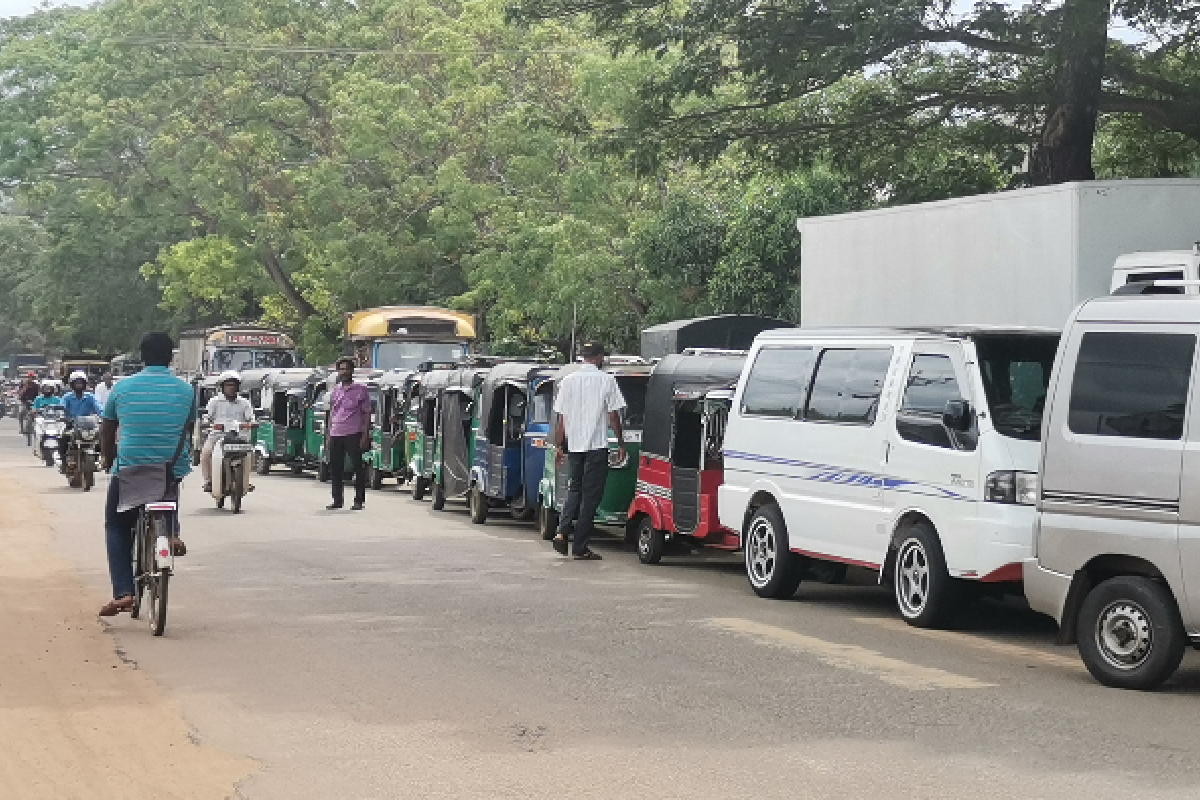
Long queues at petrol stations in many parts of Sri Lanka have once again caused concern among the public. People are reporting that there has been a disruption in the availability of petrol and diesel at fuel stations run by private companies, especially in some areas including Colombo.
Due to this, doubts have arisen among the public that there is a fuel shortage in the country again. But according to the information provided by the authorities and parties related to fuel supply, it cannot be said that there is a shortage of fuel stock in the country as a whole. The issue is mostly pointed to the distribution activities of some private distribution companies and the quantity supplied to fuel stations.
Power Minister Anura Karunathilaka has said that steps have been taken to advise private fuel distribution companies to supply fuel without shortage. He also said that the written notification will be given through the secretary of the ministry.
A special discussion will also be held between the Ministry of Power, Sri Lanka Petroleum Corporation and President Anura Kumara Dissanayake on the current situation. Through this, an attempt is being made to resolve the disruptions in private supply.
Is supply control by private companies the main reason?
The main explanation put forward by those associated with the fuel distribution sector for the situation at petrol stations is the issue with the current pricing structure.
According to the distributors, there is a situation where private companies have to buy fuel at a higher price in the international market and sell it at a lower price in the local market. It is reported that due to this, the stress on them will increase and due to this, some companies have restricted the supply of fuel.
Especially Lanka IOC, Sinopec and R.M. People from the fuel distribution sector pointed out that this problem is more common in some stations of private distribution companies like PARK. Due to this, people have to wait in queues for a long time in some areas that depend on those companies.
Meanwhile, it is reported that there is no such widespread shortage in many fuel stations owned by Sri Lanka Petroleum Corporation. Thus, the current situation is seen more as an imbalanced situation at some point in the supply chain rather than a country-wide fuel shortage crisis.
Queues in some places have been attributed to fuel stations not delivering their delivery orders on time. The Private Fuel Tanker Owners Association has also asked the public not to try to store fuel unnecessarily.
Earlier also there were issues related to transport charges in fuel supply. A demand has been made to revise the Transport Commission rates paid to fuel tanker owners as their costs have increased. Officials have also taken steps to create a new calculation system for this.
Price, Subsidy and Public Confidence
The pricing system has become crucial in solving the current problem of fuel supply. Even with the recent revision in fuel prices, the difference between the price increase in the international market and the local selling price is said to be a financial burden on private distribution companies.
The government has also taken steps to subsidize diesel to reduce its impact. The government has decided to allocate several billion rupees for diesel subsidy during October to December to prevent the impact of fuel price hike in the global market from passing directly on to the public.
But it is also clear that subsidy alone will not completely solve the supply problem. There should be a business environment where fuel companies can carry out continuous supply. At the same time, the government also needs to strengthen monitoring measures to ensure that there are no sudden interruptions in the supply of fuel to the public.
In the present incident there is a recurring theme. While officials say the country is not in a complete fuel-out situation, the impact on the public when fuel is not available at certain stations is real. If there is a long queue, people will perceive it as a fuel crisis.
Thus, it is necessary for the government to publish clear information about the actual stock level, supply volume of each company, requirements of fuel stations and supply constraints. Rumors and unnecessary tension spread rapidly in the absence of information.
Also, people queuing longer than necessary to buy fuel or trying to store large amounts of fuel at home can make the situation worse. Even if there is sufficient stock, there may be temporary shortages at some stations if too many people try to buy at once.
Therefore, the immediate solution to the current problem is to keep the supply of private distribution companies stable and solve the transport and price related issues. At the same time, the government also needs to strengthen the long-term fuel security program to prevent such a situation from reoccurring in the future.
It is one thing that the public expects in the current situation. The belief that one can get the required fuel without long queues should be re-established by going to petrol stations. Building that trust is the responsibility of the government, fuel companies and the supply chain.