

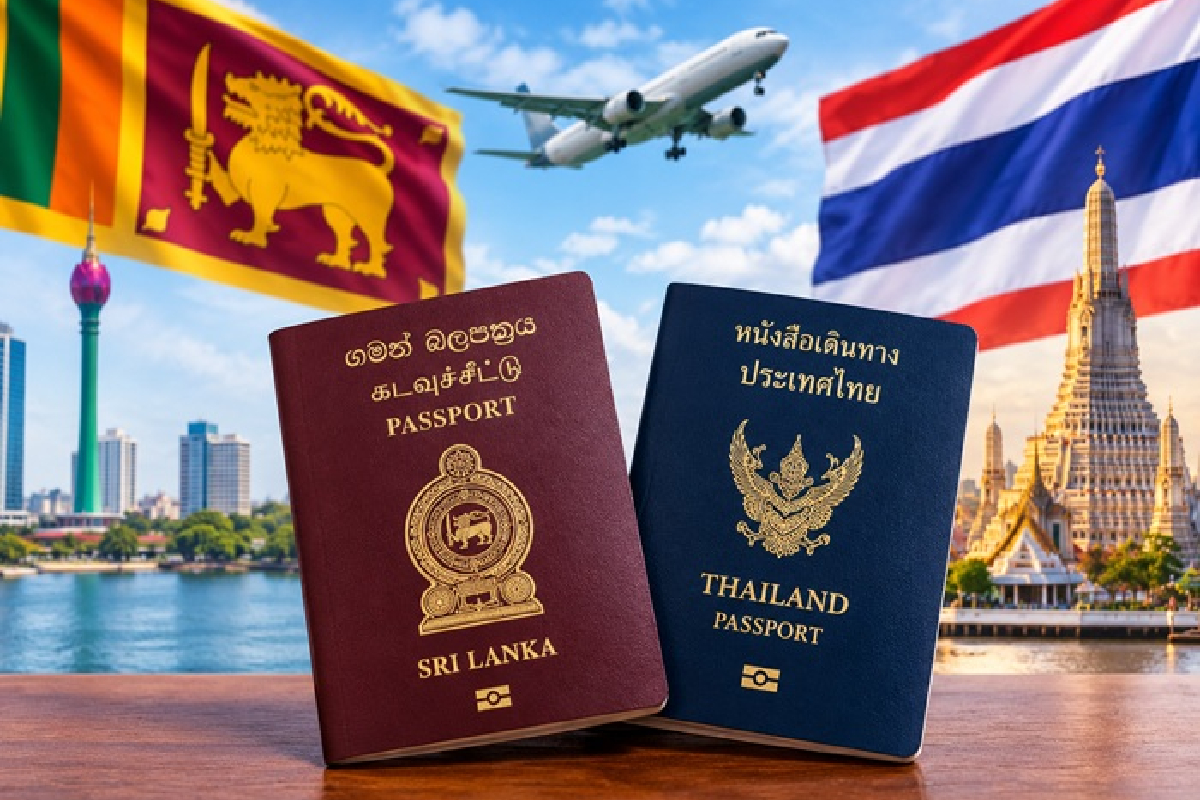
The Sri Lankan Cabinet has approved a visa waiver agreement for ordinary passport holders to further facilitate travel between the two countries. The main objectives of the agreement are to further strengthen the friendship between the two countries and increase tourism and people-to-people contacts.
Under this proposed agreement, citizens of Sri Lanka and Thailand holding valid ordinary passports will be able to enter, exit and, if necessary, travel through the other country without obtaining a visa in advance for general tourism.
A maximum stay of 30 days is allowed during one trip. However, the proposed regulations stipulate that the total stay cannot exceed 90 days in a period of 180 days. Thus, the arrangement could be useful for those traveling between the two countries for short-term tourism, family travel and personal needs.
This Agreement shall not be deemed to have come into force yet. First the two governments have to sign the agreement. After that the visa waiver will come into effect only after the relevant procedures are completed. Therefore, those who are planning to travel now should not assume that the new regulation will come into effect immediately, but should keep an eye out for official announcements.
A new opportunity for the tourism industry
Both Sri Lanka and Thailand have long-standing ties in the tourism sector. Thailand is seen as one of the top Asian tourist destinations for Sri Lankans. Similarly, Sri Lanka’s natural resources, beaches, historical sites and cultural heritage can also attract Thai tourists.
Easier visa procedures can save time and money for people planning a trip. Being able to plan a short-term trip without visa application, paperwork, waiting periods, etc. can influence travelers’ decisions. This is expected to increase the number of tourists between the two countries.
Sri Lankan Foreign Minister Vijitha Herath’s recent official visit to Thailand discussed the finalization of the visa waiver agreement for ordinary passport holders between the two countries. Both sides focused on expanding bilateral cooperation in several fields including tourism, investment, education, employment and cultural exchange.
Thus this agreement cannot be seen as an individual measure for the tourism industry. It can also be seen as part of a broader effort to expand economic and people-to-people ties between the two countries.
Increasing the number of foreign tourists in particular is an important economic goal for Sri Lanka. In addition to the opportunity to attract more tourists from Thailand to Sri Lanka, it may also become easier for Sri Lankans to visit Thailand. It can also create additional opportunities for airlines, hotels, travel agencies and small businesses related to travel.
Limitations on Visa Exemption and Considerations
While the news of being able to travel without a visa is positive for the public, this facility does not apply to all types of travel. This visa exemption cannot be used for employment, education, media activities or other activities requiring prior approval of the relevant authorities as per the proposed agreement. Such journeys may require obtaining the appropriate visa or permit in advance.
Thus there is a clear distinction between one traveling for tourism and one traveling for work or education. Just because a person can visit without a visa as an ordinary tourist should not automatically be considered to be allowed to work or engage in long-term educational activities there.
Another important point here is the time limit. While a single trip can stay up to 30 days, the total stay is limited to 90 days within a 180 day period. So frequent travelers between the two countries should be aware of this total time limit.
The agreement also gains significance in the context of Thailand’s recent sweeping changes to its visa regulations. Effective September 15, Thailand’s general tourist visa exemption system was changed, with several countries being reduced to 30 days and some countries being removed from the list. The creation of a separate bilateral visa waiver agreement for Sri Lanka is noteworthy in the context of those changes.
All in all, the proposed Visa Waiver Agreement between Sri Lanka and Thailand is a major step towards easing procedures for travelers. Reducing the burden of advance visa application especially for tourists may encourage travel between the two countries.
Taken together, the general consensus on this news is that the long-term benefit of the agreement is not only to facilitate travel, but also to increase tourism, trade and people-to-people contacts. At the same time, it is safe for travelers to confirm their plans only after the official date of signing of the agreement and the publication of the final terms.
As the relations between the two countries are already expanding in many areas such as tourism, investment, education, employment and cultural exchange, the visa waiver arrangement can give more practical importance to the relationship.